What Happens to the Brain When the Horizon Never Ends: The Neuroscience of Ocean-Induced Clarity
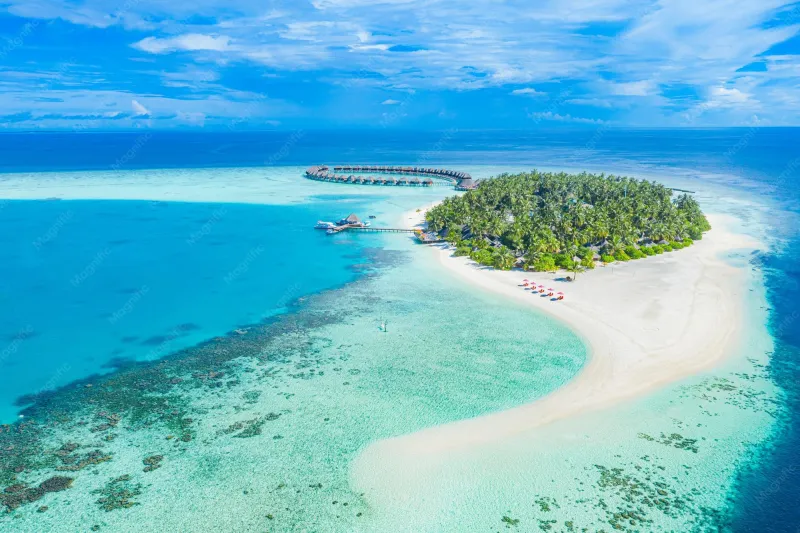
Photo: turquoise ocean horizon Maldives aerial view clear water blue lagoon, via img.freepik.com
The human brain was not designed for the environments most high-performing Americans now inhabit. It was not built for fluorescent lighting at 11 p.m., for the ambient vibration of a smartphone receiving its four-hundredth notification of the day, or for the particular cognitive load of managing a distributed team across six time zones while simultaneously preparing for a board presentation. It was shaped, over hundreds of thousands of years, by an entirely different set of inputs — among them, the open horizon.
This is not a romantic observation. It is, increasingly, a neurological one.
The Blue Space Effect: What Research Is Revealing
Environmental psychology has long recognized that natural settings produce measurable reductions in physiological stress markers. But a growing body of research is drawing a more specific conclusion: water environments — and particularly open ocean settings — generate cognitive benefits that terrestrial landscapes, including forests and mountains, do not replicate with equivalent depth.
Studies published in journals including Health & Place and Environmental Research have documented what researchers call the "blue space effect" — a measurable improvement in mental well-being, attentional capacity, and emotional regulation associated with proximity to natural bodies of water. The mechanisms are multiple. Negative ion concentrations near moving water have been linked to elevated serotonin production. The visual processing of an uninterrupted horizon activates the brain's default mode network in ways that promote associative thinking and creative problem-solving. And the rhythmic acoustic pattern of waves has been shown to induce alpha brain wave states associated with relaxed alertness — the neurological signature of flow.
For professionals whose cognitive function has been chronically impaired by sustained high-stress environments, these effects are not merely pleasant. They are, in the most literal sense, corrective.
Why Equatorial Waters Are Neurologically Distinct
Not all ocean environments are created equal, and the distinction matters for those seeking genuine cognitive restoration rather than simple relaxation.
Kanuhura Maldives sits at approximately five degrees north of the equator — a geographical position with specific implications for the human nervous system. At this latitude, day length remains remarkably consistent throughout the year, varying by less than thirty minutes between solstice and equinox. This consistency is significant because it eliminates one of the primary disruptors of circadian rhythm: the dramatic seasonal variation in light exposure that characterizes higher latitudes and that contributes substantially to the sleep disruption, mood dysregulation, and cognitive degradation experienced by professionals in cities like New York, Chicago, and San Francisco.
Equatorial sunlight also arrives at a steeper angle, producing a quality of illumination that more precisely stimulates the retinal ganglion cells responsible for regulating melatonin suppression during waking hours. In practical terms, this means that time spent in Kanuhura's natural light more effectively entrains the body's internal clock than equivalent time spent outdoors at higher latitudes — a process that has downstream effects on sleep architecture, hormonal balance, and the neurological conditions necessary for cognitive restructuring.
Neuroplasticity and the Requirement of Novelty
Neuroplasticity — the brain's capacity to form new neural connections and reorganize existing pathways — is not a passive process. It requires specific conditions, among the most important of which is the experience of genuine novelty in a low-threat environment.
This is a combination that proves elusive in the daily lives of senior executives and high-performing professionals. Their environments are frequently novel in the sense of being unpredictable and demanding, but this novelty is accompanied by elevated cortisol and the threat-detection activation of the amygdala — conditions that narrow cognitive focus rather than expanding it. The brain under sustained stress becomes efficient at a very specific range of tasks and progressively less capable of the broad, associative thinking that underlies strategic insight and creative leadership.
The Indian Ocean, experienced from the particular vantage of Kanuhura's architecture, offers something neurologically unusual: an environment of genuine novelty — unprecedented visual scale, unfamiliar soundscapes, biological rhythms entirely unlike those of the built environment — that carries no threat signal. The nervous system, receiving sensory information it cannot categorize as danger, begins the gradual process of downregulating its threat-monitoring systems. Cortisol drops. The prefrontal cortex, long subordinated to the demands of executive function under pressure, begins to reassert its capacity for complex, integrative thought.
This is the neurological mechanism behind what many Kanuhura guests describe in less technical terms: the experience of suddenly being able to think clearly about problems they had been circling for months without resolution.
Design as Neuroscience
Kanuhura's physical design operates, whether by intuition or intention, in alignment with these neurological principles. The resort's villas are oriented to maximize unobstructed ocean views — ensuring that the visual field is dominated by the blue expanse that activates the default mode network rather than by the built structures that tend to trigger task-oriented processing. Artificial lighting is calibrated to complement rather than compete with natural light cycles. The acoustic environment is shaped by water rather than by the mechanical sounds that characterize urban and suburban settings.
Even the resort's temporal rhythms — the unhurried pace of meals, the absence of programmatic pressure, the invitation to allow days to unfold according to biological rather than calendar logic — create the conditions under which neurological restoration can proceed without interruption.
The Return on Cognitive Investment
For a generation of professionals accustomed to evaluating expenditures in terms of measurable return, the case for ocean-based cognitive restoration is increasingly compelling. The research suggests that the improvements in executive function, creative capacity, and emotional regulation associated with extended blue space exposure are not transient. Neurological changes of the kind facilitated by genuine rest and novel environmental exposure persist for weeks to months following the experience — a timeline that compares favorably with the effects of conventional stress management interventions.
At Kanuhura, the Indian Ocean is not simply a backdrop. It is, in the most rigorous scientific sense, the treatment. The horizon that appears to extend without limit is, for the brain that has long been confined by the walls of obligation and urgency, something genuinely liberating: proof, experienced rather than reasoned, that the world is larger than the pressures that have come to define it.