The Permission to Feel: How the Indian Ocean Is Unlocking America's Most Guarded Leaders

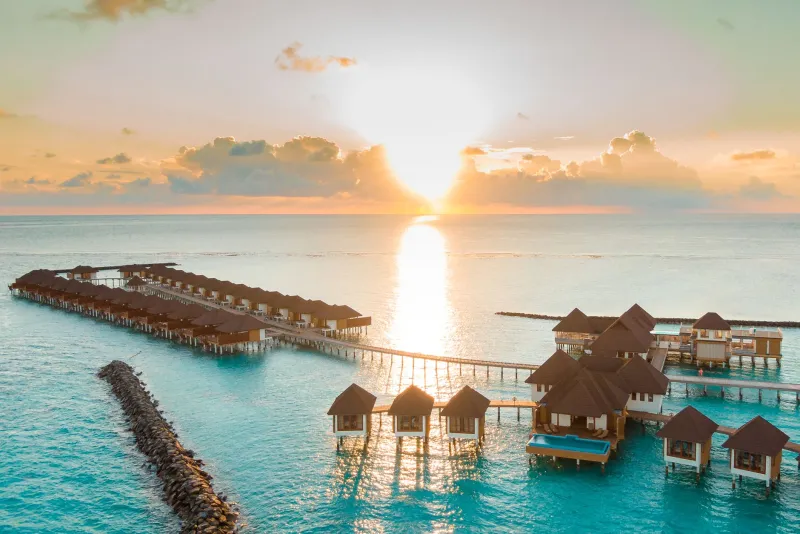
Photo: frank mckenna frankiefoto, CC0, via Wikimedia Commons
For most of his career, Marcus had been praised for his composure. As the CEO of a mid-sized logistics company headquartered in Atlanta, he had navigated two recessions, a hostile acquisition attempt, and the sudden death of a co-founder with the kind of measured steadiness that his board described, admiringly, as "unshakeable." He had internalized that description so thoroughly that he was no longer certain it was a description. It felt, after twenty years, more like a diagnosis.
"I didn't know what I actually thought about anything anymore," he said, speaking from the terrace of his villa at Kanuhura Maldives, where the lagoon shifted between shades of jade and sapphire in the late afternoon light. "I knew what I was supposed to think. I knew what I was supposed to feel. But the actual thing — whatever was underneath all that — I hadn't checked in a long time."
Marcus is not an anomaly. He is, increasingly, a representative figure.
The Architecture of Emotional Suppression
The leadership culture that shaped a generation of American executives was not, by any measure, designed to cultivate emotional fluency. The implicit contract of corporate success — particularly for men navigating industries defined by competition, hierarchy, and performance metrics — was straightforward: results were rewarded, vulnerability was managed, and feelings were largely beside the point.
This model produced, and continues to produce, individuals of remarkable capability and extraordinary interior isolation. Organizational psychologists who work with C-suite executives describe a recurring pattern: high performers who have spent decades optimizing their external output while systematically neglecting their internal landscape. The cost, they note, is rarely visible until it becomes unavoidable.
"Emotional suppression is metabolically expensive," explains Dr. Renata Osei, a clinical psychologist who specializes in leadership development and consults with Fortune 500 companies. "The energy required to maintain a consistent public persona — to monitor and regulate emotional expression across every interaction — is genuinely depleting. And unlike physical fatigue, it doesn't announce itself clearly. It tends to manifest as flatness, as a kind of low-grade disconnection from things that used to matter."
For leaders who have spent years interpreting this flatness as strength, the realization that it is, in fact, a symptom can be disorienting. And it rarely surfaces in the environments where those leaders spend most of their time.
Why the Boardroom Cannot Do This Work
The environments that high-performing Americans inhabit most consistently — offices, conference rooms, client dinners, professional events — share a common feature: they are, by design, performance contexts. Every interaction within them is shaped by role, reputation, and the implicit awareness of being observed and evaluated. In these settings, the kind of unguarded reflection that genuine emotional recalibration requires is not merely difficult. It is structurally impossible.
This is one reason why a growing number of executives are turning to environments that operate on entirely different terms. Kanuhura Maldives, situated on a private island in the northern reaches of Lhaviyani Atoll, provides something that no urban wellness center or corporate retreat facility can replicate: genuine remove. The nearest city is hours away by air. The nearest professional obligation is unreachable by design. The resort's privacy protocols ensure that guests are known, if at all, only by first name.
In this context, the social architecture that normally governs behavior simply ceases to apply. There is no one to perform for. There is no reputation to protect. There is, for perhaps the first time in years, only the individual and whatever they actually carry.
The Role of Environment in Emotional Access
The natural environment of Kanuhura does not merely provide backdrop. It actively participates in the process of emotional opening.
Research in environmental psychology has documented what practitioners of contemplative traditions have long understood: certain landscapes possess a quality that researchers term "soft fascination" — the capacity to engage attention gently, without demand, in a way that allows the deeper currents of thought and feeling to surface. The Indian Ocean, with its vast, unhurried horizon and the rhythmic constancy of its movement, exemplifies this quality in a particularly potent form.
Guests at Kanuhura describe a consistent experience: within the first day or two of arrival, something shifts. The habitual mental chatter — the planning, the problem-solving, the perpetual triage of professional life — begins to quiet. What remains is not emptiness, but something closer to honesty. Thoughts arise that have not been visited in months. Feelings surface that have been efficiently managed rather than genuinely processed.
For leaders who have spent years treating their interior lives as a variable to be controlled, this can be both unfamiliar and unexpectedly welcome.
Vulnerability as a Leadership Asset
The conversation around emotional intelligence in leadership has matured considerably in recent years. Research by organizational behavior scholars at institutions including Harvard Business School and the Wharton School has consistently demonstrated that leaders who demonstrate genuine emotional awareness — who can acknowledge uncertainty, express authentic concern, and engage with the feelings of those around them — build more resilient, more loyal, and more innovative teams than their emotionally armored counterparts.
This is not, it should be noted, an argument for emotional performance. The executive who learns to simulate vulnerability as a management technique is engaged in a more sophisticated form of the same suppression. What researchers identify as genuinely transformative is the real thing: leaders who have done sufficient interior work to be present with their own experience, and therefore capable of genuine presence with others.
That work, by its nature, cannot be scheduled into a quarterly off-site. It requires time, privacy, and an environment that makes it feel safe.
What Leaders Bring Home
The guests who return from Kanuhura having engaged in this kind of recalibration describe changes that are at once subtle and significant. They listen differently. They are less reactive under pressure. They make decisions with greater clarity, having disentangled the authentic signal of their own judgment from the accumulated noise of obligation, image management, and social expectation.
Marcus returned to Atlanta, he said, with something he had not been able to name before he left: a sense of his own interior. Not a resolution to every tension in his professional life, but an honest reckoning with what those tensions actually were. "I came back and had a conversation with my CFO that I'd been avoiding for two years," he reflected. "Not because I finally had the courage. Because I finally understood what I actually wanted to say."
That, at its core, is what Kanuhura offers the leader willing to arrive without their armor: not therapy, not transformation, but the rare and valuable experience of being, for a time, entirely themselves.