Less, Perfected: The Radical Simplicity Redefining What Five-Star Actually Means
At some point in the last decade, the luxury resort experience became exhausting.
Not the travel itself—but the performance of it. The pre-arrival questionnaires engineering every preference. The welcome amenities calibrated to signal attentiveness. The activities director materializing at breakfast with a laminated schedule of experiences, each one photographable, each one designed to fill every waking hour with something that could later be described as extraordinary.
For a certain kind of traveler, this architecture of abundance has become indistinguishable from the very pressure it was meant to provide relief from. When a vacation requires as much management as the professional life it is supposed to interrupt, something has gone wrong with the premise.
The Overcuration Problem
The hospitality industry has, for years, operated on a foundational assumption: that more is more. More amenities, more programming, more personalization signals more value. This logic made sense in an era when luxury was defined by access—when a traveler could be impressed by the mere availability of a spa treatment or a private chef.
That era has quietly ended for a specific segment of the market. High-net-worth American travelers—those for whom access to amenities is not a novelty but a baseline condition of daily life—have begun to experience something unexpected at the world's most elaborately appointed resorts: a low-grade, persistent dissatisfaction that no additional amenity can resolve.
The problem is not the quality of what is being offered. The problem is the quantity, and more specifically, the cognitive weight of navigating it. Every choice presented by a resort is a small tax on the mental energy that a traveler came to replenish. A menu of forty experiences is not a gift. For someone who makes hundreds of high-stakes decisions per week, it is simply more work.
What Kanuhura Refuses to Do
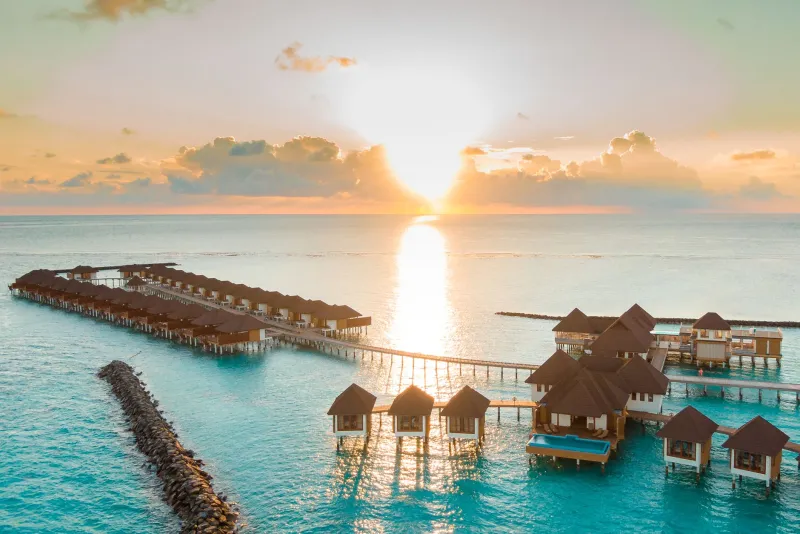
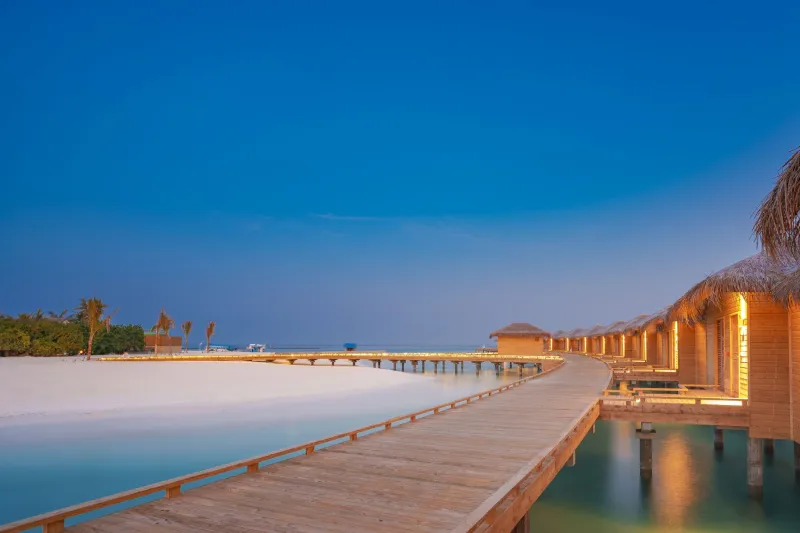
Kanuhura occupies a private island in Lhaviyani Atoll—a location that, by its very geography, imposes a productive constraint on what a resort can reasonably offer. There is an ocean. There is a lagoon. There is a reef of considerable ecological significance. There are villas of exceptional construction, designed to disappear into their surroundings rather than announce themselves.
What there is not: a casino, a convention center, a waterpark, or the sense that every square meter of the island has been monetized and programmed to within an inch of its natural character.
This restraint is not a function of limited ambition. It is the result of a coherent design philosophy that treats the natural environment as the primary amenity—and treats everything added to that environment as a potential diminishment of it. The question Kanuhura appears to ask of every proposed addition is not "would guests enjoy this?" but "does this earn its place?"
The answer, more often than not, is no. And the cumulative effect of those refusals is a resort that feels, to the traveler who has seen everything, genuinely different.
The Paradox of Presence
There is a concept in experiential psychology called "attentional restoration theory," developed by environmental psychologists Rachel and Stephen Kaplan at the University of Michigan. The theory holds that natural environments restore directed attention—the focused, effortful cognition that modern work demands—precisely because they engage what the Kaplans call "soft fascination": gentle, involuntary interest that requires no cognitive effort to sustain.
A coral reef requires no interpretation. A sunset over the Indian Ocean asks nothing of the person watching it. The movement of water across a sandbar at low tide is interesting in a way that produces rest rather than fatigue.
This is what gets lost in the overcurated resort experience: the possibility of being interested in something without being required to engage with it. When a resort fills every hour with structured programming, it inadvertently eliminates the very conditions under which genuine restoration occurs.
At Kanuhura, the unstructured hour—the afternoon with no plan, the morning with no agenda—is not an oversight. It is the point.
Redefining the Five-Star Standard
The conventional metrics of luxury hospitality—thread counts, staff-to-guest ratios, the provenance of ingredients in the restaurant—remain relevant at Kanuhura. The quality of execution across these dimensions is unimpeachable. But they are not the primary value proposition.
The primary value proposition is this: a guest at Kanuhura is never made to feel that they are failing to maximize their stay. There is no implicit pressure to book the excursion, attend the event, or photograph the moment. The resort's idea of hospitality includes, centrally, the permission to do nothing—and the environmental design to make nothing feel like everything.
For travelers who have spent significant sums at resorts that left them, paradoxically, more depleted than when they arrived, this represents something genuinely new. Not a different version of the same experience, but a different definition of what the experience is for.
The Sophisticated Traveler's Rebellion
A quiet but discernible shift is underway among the most experienced luxury travelers in the American market. The social media documentation of resort experiences—once a reliable indicator of desirability—has begun to function, for some, as a warning sign. A resort that is optimized to be photographed is, almost by definition, optimized for something other than the experience of being there.
The travelers who are finding their way to Kanuhura tend to share a common profile: they have been to the most celebrated resorts in the Caribbean, in Southeast Asia, in the Mediterranean. They are not easily impressed by amenity lists. What impresses them, increasingly, is a resort that trusts them enough to leave them alone with the ocean.
That trust, it turns out, is the rarest luxury of all.