The Private Island Advantage: Why Isolation Is Outperforming Executive Coaching for America's Top Leaders
Photo: Federal Bureau of Investigation, Public domain, via Wikimedia Commons
Let us be precise about what executive coaching actually provides. At its best, it offers a confidential space for reflection, a structured framework for examining behavioral patterns, and a skilled interlocutor who can ask the questions that colleagues and direct reports cannot. These are genuine goods, and the industry that delivers them has earned its place in the leadership development ecosystem.
But there is a growing argument — made quietly, in the conversations that happen between accomplished people who have tried both — that the most consequential leadership development does not occur in a coaching session. It occurs in the kind of silence that most Americans have never actually experienced.
The Problem with Witnessed Transformation
Every conventional leadership development modality — coaching, group workshops, peer advisory boards, even the celebrated executive programs at institutions like Harvard Business School and Wharton — shares a structural characteristic: transformation is witnessed. There is always another person in the room, another set of eyes observing the moment of vulnerability or insight, another professional relationship that must be managed even as one attempts to transcend the very patterns that relationship has come to know.
This is not a trivial limitation. For leaders who have spent careers mastering the art of impression management — whose professional survival has depended, at least in part, on controlling how they are perceived by others — the presence of an observer, however skilled and well-intentioned, introduces a variable that fundamentally alters the experience. The leader is not simply reflecting. The leader is reflecting while being watched. These are different cognitive and emotional states, and they produce different outcomes.
The most honest thinking tends to occur in the absence of an audience.
What Radical Privacy Actually Enables
Consider what becomes possible when a leader of genuine consequence — a founder managing a company valued in the billions, a CEO navigating a transformational acquisition, an executive whose every public statement moves markets — is removed entirely from the social architecture of their professional life.
No direct reports to manage. No board members to reassure. No investors whose confidence must be maintained. No communications team monitoring the optics of every expressed uncertainty. For the first time, perhaps in years, the individual beneath the title is free to think without consequence.
This is not a small thing. The decisions that define careers — the acquisitions that either create or destroy generational value, the pivots that either capture emerging markets or strand organizations in obsolescence, the leadership choices that either build extraordinary cultures or quietly destroy them — these decisions require a quality of thinking that the pressured, observed, perpetually-accountable professional environment actively suppresses.
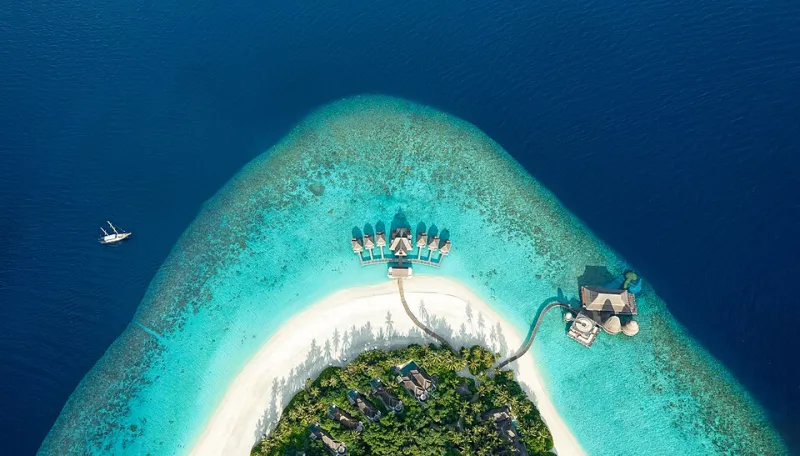
Kanuhura Maldives, occupying its own private island in the Lhaviyani Atoll, provides the physical and social architecture for exactly this kind of thinking. The resort's geography enforces a separation from professional context that no downtown coaching office, however discreet, can replicate. The Indian Ocean does not care about your market capitalization. The lagoon has no opinion about your last earnings call. This indifference, experienced physically rather than simply imagined, is more liberating than it sounds.
The Confidentiality Premium
There is another dimension to this conversation that is rarely discussed with full candor: the confidentiality limitations of conventional leadership development.
Executive coaches, for all their professional ethics, exist within networks. They have other clients, some of whom operate in adjacent industries. They present at conferences. They write books. The insights they develop through their work — even when appropriately anonymized — circulate in professional communities in ways that their clients cannot fully control or predict.
For leaders operating at the highest levels of American commerce, the strategic and personal vulnerabilities explored in a coaching engagement represent genuine competitive and reputational risk. The recognition of this risk has driven a subset of the most sophisticated executives toward an alternative that offers something coaching structurally cannot: the complete absence of a third party.
A week at Kanuhura produces no notes, no frameworks, no case studies. It produces only the private interior experience of a leader who has been given the time, the environment, and the solitude to think without interruption. Whatever insights emerge belong entirely and exclusively to the person who generated them.
The Indian Ocean as Interlocutor
This is, admittedly, a less tidy proposition than the structured arc of a coaching engagement. There is no agenda, no session plan, no competency framework against which progress is measured. What Kanuhura offers instead is something more fundamental: an environment of extraordinary beauty and complete calm that, over the course of several days, has a way of clarifying what actually matters.
Leaders who have spent extended time at the resort describe a consistent progression. The first day or two are characterized by the restless energy of a mind accustomed to constant input — the impulse to check communications, to plan, to produce. As this energy gradually dissipates, something more interesting emerges: the capacity to sit with questions that have been deferred, sometimes for years, beneath the noise of operational demands.
The questions that surface in this space are rarely tactical. They are the questions of purpose, of legacy, of alignment between stated values and actual choices. They are, in the language of executive development, the highest-order leadership questions — and they are the ones that a coaching engagement, for all its skill, can only approximate the conditions to address.
An Investment Worth Reframing
The comparison between a premium executive coaching engagement and a private retreat at Kanuhura is instructive not because the experiences are equivalent, but because they are competing for the same budget line and the same scarce resource: the leader's time and attention.
For those who have exhausted the conventional approaches — who have done the coaching, attended the offsites, read the frameworks, and still find themselves returning to the same patterns and the same unresolved strategic questions — the private island proposition deserves serious consideration.
Not as an indulgence. Not as a reward for performance. But as a deliberate investment in the conditions under which genuine transformation, the kind that is self-generated rather than facilitated, becomes possible.
At Kanuhura, the Indian Ocean is patient. The horizon is available around the clock. And the most important leadership conversation you will ever have is the one you conduct entirely with yourself, in a silence deep enough to finally hear the answers.