Reef to Reservation: Why the Meal You'll Remember from the Maldives Isn't at a Restaurant Back Home
A quiet shift has occurred in how Americans book luxury travel. Surveys of high-end travelers now consistently place cuisine at or near the top of the decision hierarchy — ahead of room categories, ahead of spa menus, sometimes ahead of destination itself. The five-star traveler of a decade ago asked about the villa. The five-star traveler of today asks about the chef.
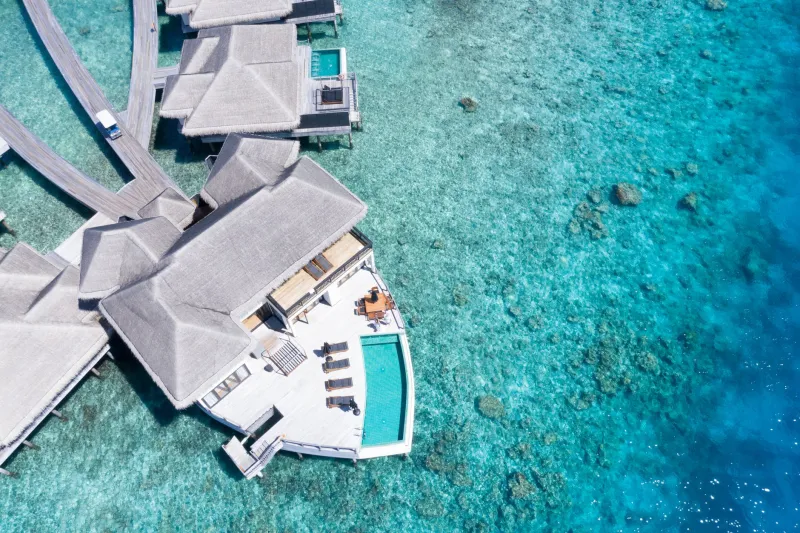
At Kanuhura, this shift has been met not with a marketing response but with a culinary one. On a private island in the Lhaviyani Atoll, an hour by seaplane from Malé, the kitchens operate under conditions most chefs can only imagine: a living reef at the doorstep, a supply chain measured in hours rather than days, and a dining room that changes with the tide and the weather and the light.
The Shortest Supply Chain in Luxury Dining
Begin with the fish, because everything begins with the fish. The yellowfin tuna on tonight's menu was swimming in the Indian Ocean this morning. The reef fish were landed by local Maldivian dhoni, purchased through relationships the culinary team has built over years with fishermen from nearby inhabited islands.
This proximity changes the cooking. There is no preservation, no freezing, no compromise — only fish so fresh that the kitchen's primary obligation is restraint. Grilled over open flame with little more than lime, sea salt, and local chili; cured in coconut vinegar; served sashimi-style within hours of the catch. American diners accustomed to excellent coastal seafood will notice the difference on the first plate: a sweetness and firmness that has nothing to do with technique and everything to do with time.
The Tables You Cannot Replicate
What elevates dining at Kanuhura beyond even exceptional food is the setting — and here, the competition back home is not merely beaten; it is rendered irrelevant.
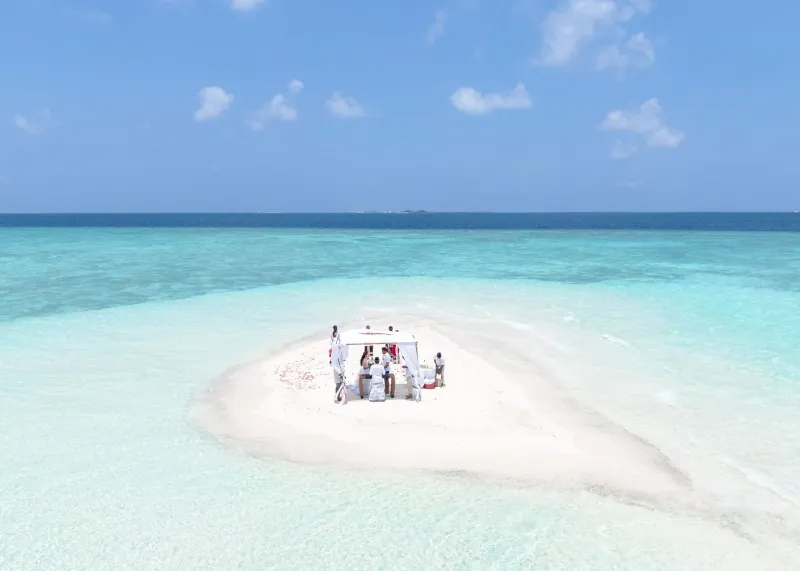
Consider the sandbank dinner: a table for two on a spit of white sand that appears and disappears with the tide, attended by a private chef and a butler, surrounded by water on every horizon. There is no restaurant in Manhattan, Napa, or Miami that can offer this, because it cannot be built — only borrowed from the ocean for a few hours.
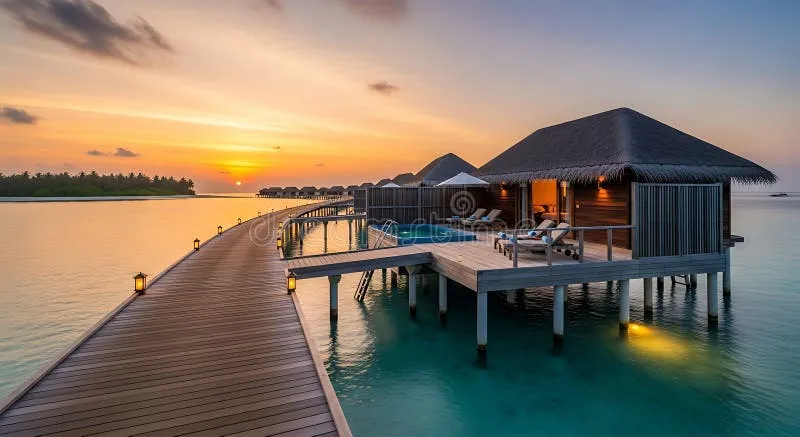
Consider the overwater restaurant, where the floor is glass and the reef is visible beneath your table, or the barefoot barbecues on the beach, where the line between kitchen and shoreline dissolves entirely. Each setting imposes its own menu: lighter fare at noon, flame-driven cooking at dusk, and after dark, desserts built around coconut, pandan, and tropical fruit that never survives the journey to a US supermarket.
Sustainability as a Working Practice
American luxury travelers have grown appropriately skeptical of sustainability claims. What distinguishes Kanuhura's approach is that it is operational rather than rhetorical.
The reef fishery is managed with the health of the atoll in mind — no endangered species, no destructive practices, sourcing that supports the neighboring island communities whose livelihoods depend on the same waters. Kitchen gardens supply herbs and produce. Water is bottled on-island, eliminating the plastic stream that plagues remote resorts. Waste is managed with the seriousness a fragile ecosystem demands.
For the guest, this translates into a simple, verifiable fact: the meal on the table did not cost the ocean anything it could not afford.
The Showmanship of Restraint
There is a temptation, in resort dining, toward performance — foam and theatrics and plates designed for the camera. Kanuhura's kitchens mostly resist it. The showmanship here is quieter: a chef who appears at your table to describe the morning's catch; a sommelier who pairs a crisp old-world white with coconut-cured tuna and explains why; the ritual of a Maldivian curry prepared with spice blends that vary from island to island, as distinct as regional barbecue in the American South.
It is food that respects both its origins and its audience — which is precisely what the contemporary American luxury traveler, better fed and better informed than any generation before, has learned to ask for.
Book the sandbank table for the second or third night, after arrival jet lag has lifted and appetite has returned in full. Come hungry. Leave with a benchmark your favorite restaurant back home will struggle to meet.