Alone on Purpose: Why the Ultra-Wealthy Are Choosing Solitude Over Status Dinners
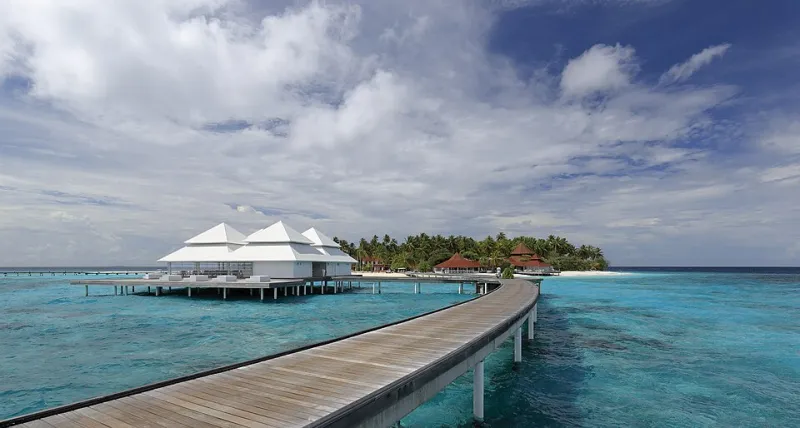
Photo: Martin Falbisoner, CC BY-SA 4.0, via Wikimedia Commons
There is a particular kind of exhaustion that no productivity app can fix. It accumulates not from overwork alone, but from the relentless performance of a life lived in full view — the charity galas, the industry panels, the obligatory dinners where conversation is currency and absence is noticed. For a growing cohort of high-net-worth Americans, the antidote is not a better social calendar. It is no calendar at all.
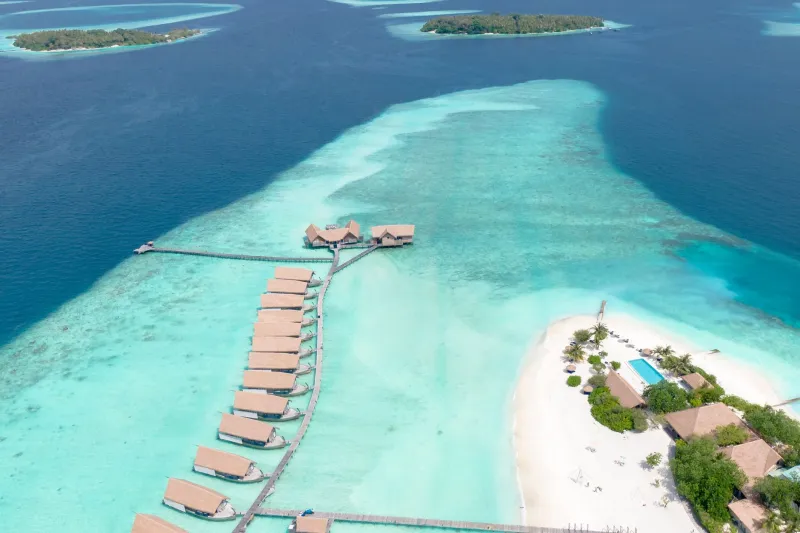
At Kanuhura Maldives, a private island resort positioned at the northern tip of Lhaviyani Atoll, a notable shift has been observed among its most discerning guests. Solo arrivals — individuals traveling without partners, families, or entourages — have increased meaningfully in recent seasons. These are not travelers fleeing loneliness. They are, by most measures, among the most socially connected people in the country. What they are seeking is something rarer than connection: genuine solitude, delivered at a standard that matches every other dimension of their lives.
The Paradox at the Heart of High Achievement
Behavioral scientists have long studied what they describe as the "social performance tax" — the cognitive and emotional cost of maintaining a public-facing identity across professional and social domains. Dr. Stuart Heller, a researcher in executive psychology based in Chicago, describes it plainly: "The higher someone rises in their field, the more their social interactions become transactional, even when they are ostensibly personal. Every dinner, every event, every conversation carries an implicit weight of expectation. The brain never fully disengages."
This is precisely the paradox that defines the experience of many ultra-high-net-worth individuals. Surrounded by people, they are rarely truly alone. Immersed in conversation, they are rarely genuinely heard. The social calendar, once a symbol of vitality and relevance, has quietly become another obligation — one that leaves little room for the kind of reflective stillness that meaningful decision-making actually requires.
Solitude, in this context, is not absence. It is presence, finally directed inward.
What Kanuhura Makes Possible
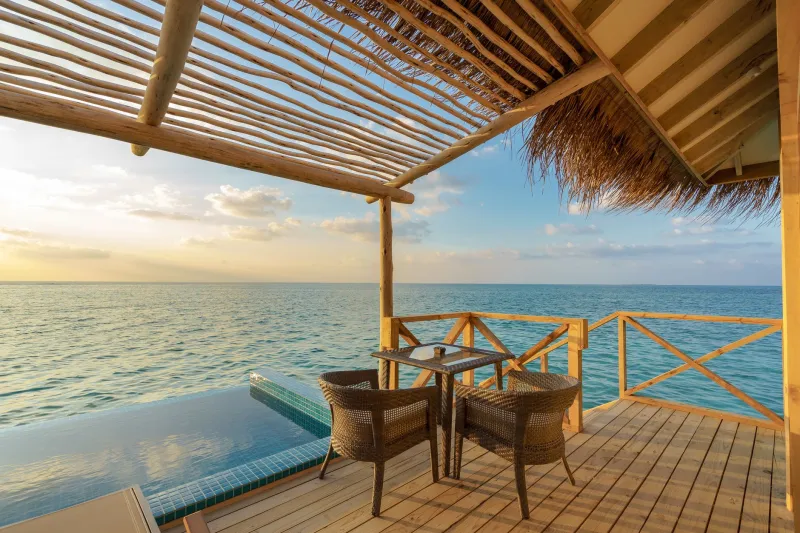
The architecture of Kanuhura is, in many respects, designed for exactly this kind of intentional withdrawal. The resort's overwater villas and beachfront residences are engineered around privacy — each property set at a remove from its neighbors, each furnished with the understanding that the guest who arrives alone does so by deliberate choice, not circumstance.
Personal butler service, available around the clock, operates on a principle that distinguishes attentiveness from intrusion. Guests communicate their preferences once; thereafter, the experience anticipates rather than interrupts. Meals appear when desired. The villa is refreshed during a morning swim. A private snorkeling excursion is arranged without the choreography of group scheduling. The effect is a kind of invisible infrastructure that removes every logistical friction from the experience of simply being.
For guests accustomed to managing teams, households, and complex itineraries, this frictionless environment produces something unexpected: the unfamiliar sensation of having nothing to manage.
Redefining Visibility as a Value
American culture has long equated visibility with relevance. To be seen — at the right events, in the right company, in the right publications — is to signal vitality, influence, and arrival. The fear of missing out, now embedded in the cultural lexicon, is not merely a social anxiety. For high achievers, it is a professional calculus, a concern that stepping back from the circuit means stepping out of the conversation.
Yet something is shifting. Among the guests who return to Kanuhura for solo retreats — some annually, some more frequently — there is a consistent reframing of what visibility actually costs. "I spent fifteen years making sure the right people knew where I was," one guest, a venture capital partner from San Francisco, reflected during a recent stay. "At some point, I realized I had no idea where I was myself."
This reorientation does not represent a retreat from ambition. Rather, it reflects a more sophisticated understanding of what sustains high performance over time. Introspection, as organizational psychologists increasingly argue, is not a soft skill. It is a strategic one — the capacity to process experience, recalibrate values, and return to action with greater clarity and intentionality.
The Indian Ocean as Mirror
There is something about the particular quality of light and stillness at Kanuhura that guests describe with unusual consistency. The horizon here is uninterrupted — no coastline, no vessel, no competing visual claim on attention. The lagoon shifts through colors that have no precise names in English. The silence at night is comprehensive in a way that most Americans have never actually experienced.
Neurologically, this environment does something measurable. Research on restorative environments — spaces characterized by fascination without demand, extent without enclosure, and compatibility with personal goals — consistently demonstrates reductions in cortisol, improvements in attentional capacity, and increases in what psychologists call "autobiographical thinking," the reflective self-narrative that underpins identity coherence.
In simpler terms: the Indian Ocean gives the mind room to hear itself.
Solitude as the New Status Symbol
There is an emerging social grammar around the solo luxury retreat that is worth noting. Among certain circles, the announcement of a week alone at a private island resort no longer reads as isolation or eccentricity. It reads as mastery — of one's schedule, one's social obligations, and one's own interior life. It signals a level of self-possession that no group trip, however exclusive, can convey.
This is not, at its core, a rejection of community. Guests who seek solitude at Kanuhura return to their relationships and responsibilities with a quality of presence that social saturation rarely produces. They have, in the truest sense, been somewhere. Not geographically — though the coordinates are extraordinary — but internally.
Kanuhura offers the conditions for that journey: the privacy, the beauty, the seamless service, and the vast, unhurried expanse of the Indian Ocean. What guests discover within that space is, by definition, entirely their own.