Quiet as Currency: How America's Most Powerful Executives Are Buying Back Their Thinking Minds

There is a peculiar irony at the center of modern corporate life. The leaders most responsible for setting the direction of billion-dollar enterprises are often the least capable of thinking clearly. Not because they lack intelligence—but because they have surrendered the one condition under which intelligence actually functions at its highest level: silence.
This is no longer a philosophical observation. It is a measurable, documented crisis of cognitive performance. And a small but influential group of American executives has begun treating its remedy with the same seriousness they bring to quarterly earnings calls.
The Neuroscience of Noise
Researchers at Duke University's Institute for Brain Sciences have demonstrated that periods of sustained quiet—not meditation, not guided relaxation, but simple, unstructured silence—stimulate the hippocampus, the brain region most directly associated with integrative thinking and memory consolidation. In a landmark 2013 study published in Brain Structure and Function, mice exposed to two hours of silence daily developed significantly more new neurons in the hippocampus than those exposed to ambient noise or even Mozart.
The implications for human decision-making are difficult to overstate. When the brain is not processing incoming stimuli, it defaults to what neuroscientists call the default mode network—a state of internal processing that enables pattern recognition, long-range planning, and the kind of associative thinking that produces genuine insight. The always-on culture of American corporate leadership, with its relentless stream of Slack notifications, back-to-back video calls, and open-plan offices, systematically suppresses this network.
The result is a leadership class that is perpetually reactive rather than strategically generative. Decisions get made, but they are made in a state of cognitive depletion that no amount of caffeine or productivity software can fully compensate for.
What the Corner Office Cannot Provide
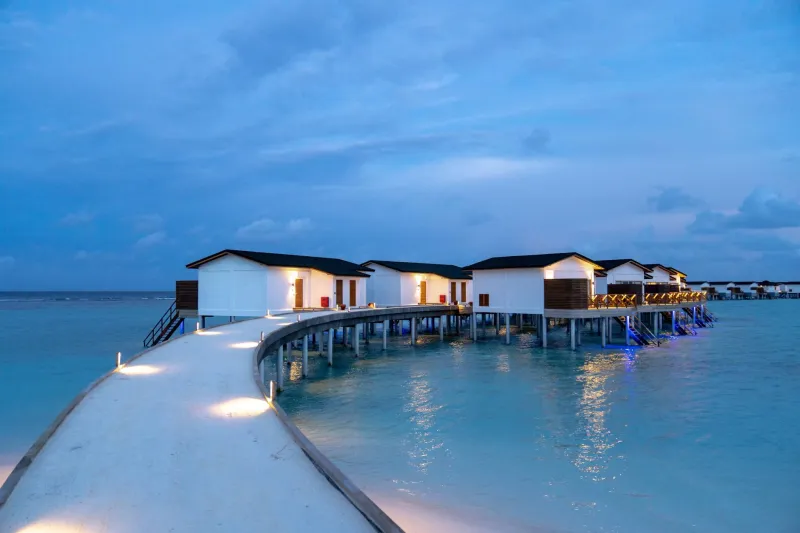
Consider the anonymous account of a managing partner at a private equity firm overseeing more than $4 billion in assets. In the spring of 2022, facing a portfolio restructuring decision that had stalled his leadership team for months, he booked an extended stay at a remote overwater villa in the Maldives—not for vacation, but with the explicit intention of doing nothing. No agenda. No advisory calls. No prepared materials.
Within four days, he reports, the decision had essentially resolved itself. Not through sudden inspiration, but through a gradual clarification that he describes as his mind "remembering how to think." The restructuring strategy he returned with has since generated returns that significantly outperformed comparable positions in his portfolio.
His experience is not isolated. A chief technology officer at a publicly traded software company describes a similar pattern: two weeks of near-complete sensory reduction at a Maldivian resort preceded what she calls the most productive six-month stretch of her career. A founding partner at a venture capital firm credits an unscheduled ten-day retreat with the clarity that led him to exit a position his team had been reluctant to abandon—a move that protected his fund from a subsequent market correction.
None of these individuals would speak on the record. That reticence is itself revealing: in a business culture that monetizes every personal brand moment, the executives who have discovered the value of silence are guarding it closely.
Why the Maldives, and Why Kanuhura
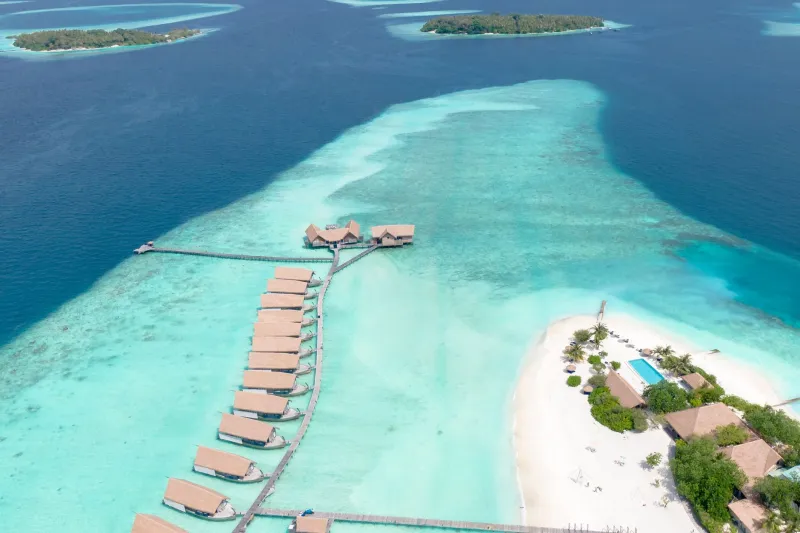
Geography matters here in ways that are more than aesthetic. The archipelago of the Maldives sits in the central Indian Ocean, removed from the flight paths, time zones, and ambient electromagnetic density of the world's major commercial centers. At Kanuhura—a privately held island in Lhaviyani Atoll, accessible only by seaplane—the sensory environment is categorically different from anything available on the continental United States.
There is no traffic noise. There is no light pollution. The soundscape is composed almost entirely of wind, water, and the occasional call of a seabird. Nighttime air temperatures hover in a range that sleep researchers associate with optimal slow-wave sleep—the restorative phase most compromised by chronic stress and irregular schedules.
Kanuhura's design philosophy reinforces this environmental advantage. The resort's architecture does not compete with its setting; it defers to it. Villas are positioned to maximize ocean sightlines and minimize visual clutter. Programming is available but never imposed. Guests who wish to spend three days in complete solitude are accommodated without comment or pressure.
This is not accidental. It reflects an understanding that the guests who seek out Kanuhura are not looking to be entertained. They are looking to recover a faculty they have allowed to atrophy.
Silence as a Line Item
The corporate world has spent decades optimizing for productivity through addition: more tools, more data, more connectivity. The emerging countermovement among elite performers suggests that the next competitive frontier may be subtractive—that the executives who learn to protect their cognitive white space will consistently outperform those who do not.
Some organizations are beginning to formalize this. A small number of forward-thinking boards now include provisions in executive compensation packages for mandatory disconnected retreats. Several leadership development firms have begun incorporating extended solitude into senior coaching programs. The logic is straightforward: a CEO who makes three better decisions per year because her thinking is clearer will generate more enterprise value than one who makes thirty decisions per year in a state of chronic cognitive overload.
The math, once articulated, is not difficult to accept. What is difficult is the cultural permission to act on it—to book the flight, to surrender the devices, to trust that stepping away from the noise is not abdication but preparation.
That permission, for those who have already made the journey to Kanuhura, turns out to be the easiest part.