The Connection Cure: How Kanuhura's Intimate Spaces Are Rebuilding What Modern Life Has Broken

The surgeon general called it an epidemic. Harvard researchers have spent decades documenting its consequences. And yet, despite the warnings, the statistics, and the growing cultural awareness, loneliness continues to hollow out the lives of Americans at every income level, every professional tier, and every age bracket. Paradoxically, the higher one climbs — the more packed the calendar, the more crowded the inbox — the more acute the isolation tends to become.
For a particular cohort of high-achieving Americans, the problem is not a lack of people. It is a lack of presence. Surrounded by colleagues, staff, family members, and professional acquaintances, many executives, founders, and senior leaders describe a persistent sense of disconnection that no networking event, wellness app, or weekend retreat has managed to resolve.
Kanuhura Maldives was not designed as a therapeutic intervention. And yet, with increasing frequency, guests are returning home and describing something that sounds remarkably like healing.
The Architecture of Togetherness
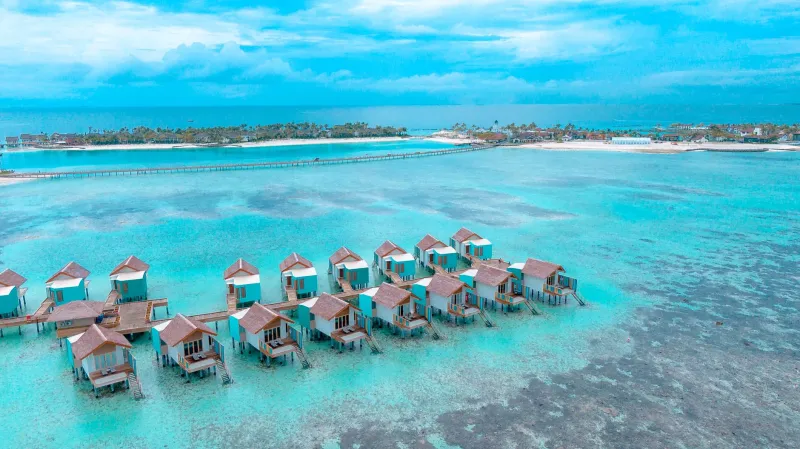
What distinguishes Kanuhura from virtually every other luxury property in the Indian Ocean is not simply what it offers, but how it is arranged. The resort occupies its own private island in the Lhaviyani Atoll, and its physical layout reflects a philosophy that prioritizes encounter over isolation — a subtle but significant departure from the prevailing design logic of ultra-luxury travel, which often prizes seclusion above all else.
Communal fire pits sit at natural gathering points along the beach. The overwater bar is positioned not at the resort's periphery but at its social center. Dining venues are configured to encourage lingering rather than efficient turnover. Even the pathways between villas are designed with gentle intentionality, creating the conditions for unhurried conversation between guests who might otherwise retreat behind the walls of their private accommodations.
"There is a difference between privacy and isolation," notes one hospitality design consultant who has studied the resort's layout. "Kanuhura gives guests genuine privacy when they want it. But it never makes solitude the default. The architecture gently nudges people toward one another."
What Psychologists Are Observing
Dr. Elena Marchetti, a clinical psychologist who specializes in high-performance individuals and has accompanied several executive clients on Maldives retreats, describes the effect in terms that go beyond the anecdotal.
"The environments in which we attempt to connect matter enormously," she explains. "Most of the spaces where American professionals are expected to socialize — conference rooms, cocktail parties, corporate dinners — are structured around performance and evaluation. People are always, on some level, being assessed. That baseline anxiety makes genuine vulnerability almost impossible."
Kanuhura, she argues, dismantles that dynamic through a combination of physical beauty, sensory calm, and deliberate unhurriedness. "When you are sitting at the edge of the Indian Ocean, watching the sun dissolve into the water, the usual social calculus simply does not apply. People say things they would never say in a boardroom. They listen in ways they rarely do at home. The environment does a significant portion of the therapeutic work."
The persistence of these effects is what surprises her most. Several of her clients have reported that relationships formed or deepened at Kanuhura — whether with a spouse, a longtime colleague, or an entirely new acquaintance — have maintained their quality months after the trip concluded. "That is not typical of vacation experiences. Usually, the warmth fades within days of returning to normal life. Something about the depth of connection that happens here seems to be more durable."
The Executive Perspective
Marcos Delgado, a private equity managing partner based in Miami, traveled to Kanuhura with his wife and two adult children for a ten-day stay last spring. He arrived, by his own description, as someone who had not had an unguarded conversation in years.
"I talk to people all day long," he says. "Lawyers, investors, portfolio company CEOs, my own partners. But it is all transactional, even when it pretends not to be. I had genuinely forgotten what it felt like to just — talk. To not be managing an impression or working toward an outcome."
The shift, he recalls, happened gradually. An evening at the resort's communal fire pit led to a conversation with another guest — a retired federal judge from Chicago — that lasted nearly four hours. The following morning, a guided snorkeling excursion with his daughter produced what he describes as "the first real conversation we had had in probably three years."
"I am not a sentimental person," he says carefully. "But I came home different. My team noticed it. My wife noticed it. Whatever happened out there, it was not just relaxation. It was something more specific than that."
Beyond the Digital Detox
Much of the contemporary conversation around wellness travel focuses on the benefits of disconnecting from technology. And while Kanuhura certainly provides the conditions for a meaningful digital detox, the more significant phenomenon may be what fills the space that screens vacate.
Silicon Valley has invested billions in platforms designed to facilitate human connection. The results, measured against any meaningful standard of relational depth or psychological wellbeing, have been largely disappointing. What Kanuhura offers is, in some respects, the inverse of the social media model: fewer connections, but substantially richer ones. Conversations that unfold over hours rather than seconds. Shared experiences — a night dive, a sunset sail, a private dining experience on a sandbank — that create the kind of mutual memory that sustains relationships across time and distance.
"Technology optimizes for scale," observes Dr. Marchetti. "It gives you access to thousands of people at the cost of genuine depth with any of them. What a place like Kanuhura offers is the opposite trade-off. Fewer people, but real ones. And for most of my clients, that is precisely what they have been starving for."
A Different Kind of Return on Investment
For the high-achieving Americans who represent Kanuhura's core guest profile, the instinct to measure experience in terms of outcomes is almost impossible to suppress. And so it is worth stating plainly: the evidence, both clinical and anecdotal, suggests that the investment of time and presence at Kanuhura generates returns that are difficult to quantify but genuinely significant.
Stronger marriages. Repaired relationships with adult children. Professional partnerships deepened by shared experience rather than shared spreadsheets. A renewed capacity for presence that, for many guests, had been gradually eroded by years of distraction and performance.
The Indian Ocean does not solve the loneliness epidemic. But at the edge of its luminous waters, on an island designed with uncommon care for the conditions of human flourishing, something shifts. And for many guests, that shift turns out to be exactly what they did not know they needed most.