Seven Days, Months of Clarity: The Neuroscience Behind What Kanuhura Does to Your Brain
There is a particular moment that many Kanuhura guests describe with striking consistency. It arrives sometime around the third day — perhaps while floating in the lagoon at dusk, or sitting in silence on the villa's private deck as the Indian Ocean exhales its evening tide. The relentless mental chatter that defines modern American professional life simply... stops. Not suppressed. Not managed. Gone.
For years, this phenomenon was attributed to the obvious: rest, beauty, distance from the office. But a growing body of neuroscientific research suggests something considerably more profound is occurring — and that its effects endure long after the return flight touches down in New York, Chicago, or Los Angeles.
What the Research Actually Shows
Dr. Lisa Feldman Barrett, a neuroscientist at Northeastern University whose work on brain predictive processing has reshaped how researchers understand emotional regulation, has described the brain's fundamental operating principle as one of constant energy budgeting. The modern professional's brain, she and her colleagues argue, is perpetually running at a deficit — predicting threats, managing social complexity, and processing information at a pace the human nervous system was never designed to sustain.
When that deficit is interrupted by an environment of genuine safety, natural beauty, and temporal spaciousness, the brain does not merely rest. It reorganizes.
"Extended exposure to low-threat, high-sensory-richness environments has been associated with measurable changes in default mode network activity," explains Dr. Marcus Raichle of Washington University in St. Louis, whose foundational research on the default mode network — the brain system responsible for self-reflection, creativity, and long-term planning — helped establish why genuine mental downtime is not a luxury but a neurological necessity. "The brain uses these periods to consolidate, prune, and essentially upgrade its own architecture."
The implications for the serious professional are significant. This is not the science of relaxation. This is the science of cognitive performance.
The Kanuhura Environment as a Neurological Catalyst
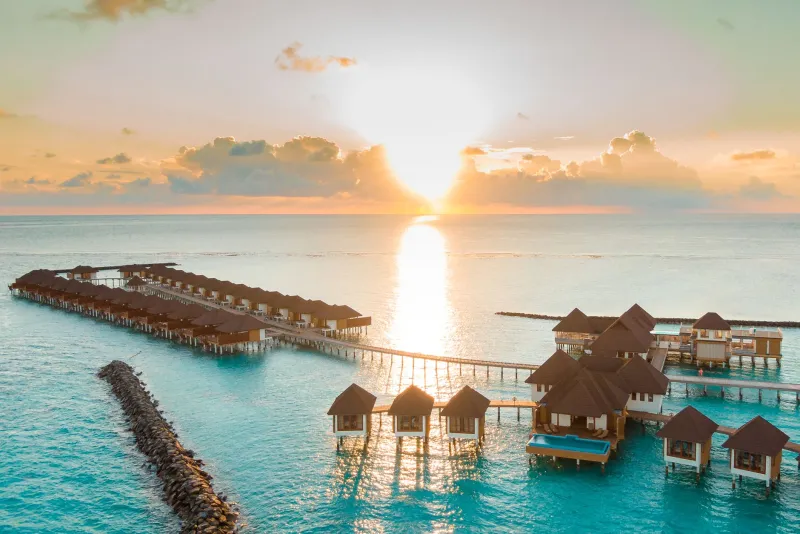
Not all resorts are neurologically equal. What distinguishes Kanuhura — situated on its own private island in the Lhaviyani Atoll, roughly 45 minutes by seaplane from Malé — is the particular constellation of environmental conditions it offers, conditions that align with what researchers now understand to be optimal for neural restoration.
The resort's extraordinary isolation eliminates what neuroscientists call "ambient social threat" — the low-grade vigilance that urban environments and open-plan offices perpetually activate. The absence of crowds, noise pollution, and the visual complexity of city architecture allows the brain's threat-detection systems to genuinely disengage, often for the first time in months.
The Indian Ocean itself plays a documented role. Research published in the Journal of Environmental Psychology has demonstrated that proximity to blue space — open water environments — produces measurable reductions in cortisol and increases in serotonin production. The effect is amplified, researchers note, when the water is warm, clear, and actively engaged with, as guests at Kanuhura routinely do through snorkeling, diving, and open-water swimming in the resort's protected lagoon.
Kanuhura's culinary philosophy adds yet another layer. The resort's emphasis on fresh, whole-food preparations — many incorporating locally sourced seafood and tropical produce — aligns with emerging research on the gut-brain axis, which has established bidirectional communication between intestinal microbiome health and cognitive function. Guests are, quite literally, eating their way to sharper neural performance.
What Returning Guests Have Documented
The anecdotal evidence, while not peer-reviewed, is remarkably consistent. Among Kanuhura guests who returned to senior professional roles in the United States, several have described improvements in cognitive function that persisted well beyond the first week home.
One managing director at a private equity firm in San Francisco described the six weeks following her stay as "the most productive quarter I've had in five years — not because I worked harder, but because I could see more clearly what actually mattered." A chief medical officer from a hospital network in Boston noted that his capacity for complex decision-making felt qualitatively different for approximately three months after returning: "I was less reactive. I was holding more information in working memory without feeling overwhelmed."
These observations correspond to what researchers call "stress inoculation reversal" — the gradual unwinding of chronic stress adaptations that, over time, actually impair the prefrontal cortex's executive function. When cortisol levels normalize and remain stable for an extended period, the prefrontal cortex — responsible for judgment, planning, and impulse control — begins to recover function that chronic stress had quietly eroded.
A week at Kanuhura, it appears, may be long enough to initiate that recovery in ways that a long weekend in the Berkshires or a spa day in Manhattan simply cannot match.
The Compound Effect of Sensory Immersion
What makes Kanuhura's environment particularly potent from a neurological standpoint is the compound effect of multiple restorative inputs operating simultaneously. The warm equatorial light regulates circadian rhythms disrupted by screen exposure and artificial lighting. The rhythmic sound of the ocean activates the parasympathetic nervous system with a consistency that sleep apps attempt — and largely fail — to replicate. The tactile experience of warm sand, open water, and unhurried movement recalibrates proprioceptive awareness in ways that desk-bound professionals rarely access.
Dr. Eva Selhub, a Harvard Medical School physician and researcher who has written extensively on the physiology of resilience, describes this kind of multi-sensory natural immersion as "a full-system reset — not just for the mind, but for the body's regulatory networks that support mental performance."
The brain, she notes, is not separate from the body it inhabits. When the body's stress architecture is dismantled layer by layer — through movement, nutrition, sleep quality, and environmental safety — the mind that emerges is not merely rested. It is, in a meaningful physiological sense, rebuilt.
Planning for Maximum Neurological Return
For the American professional considering Kanuhura as a strategic investment in cognitive performance, research suggests several principles worth considering.
Duration matters. Three days produces rest. Seven days produces restructuring. Studies on neural plasticity consistently demonstrate that meaningful changes in default mode network function require sustained environmental input — not a weekend, but a week.
Digital detachment amplifies the effect. Kanuhura's natural isolation makes genuine disconnection achievable in a way that few other environments can. Guests who resist the pull of email and news cycles report significantly deeper restoration than those who remain partially tethered to professional obligations.
Finally, the transition back matters. The neuroscience of reconsolidation — the process by which new neural patterns become stable — suggests that the 72 hours following a restorative experience are critical. How one re-enters professional life determines, in part, how much of what was gained is preserved.
The Maldives will always be extraordinary. Kanuhura, it turns out, may also be essential.