Holding On: A Professional's Guide to Preserving the Peace You Found at Kanuhura
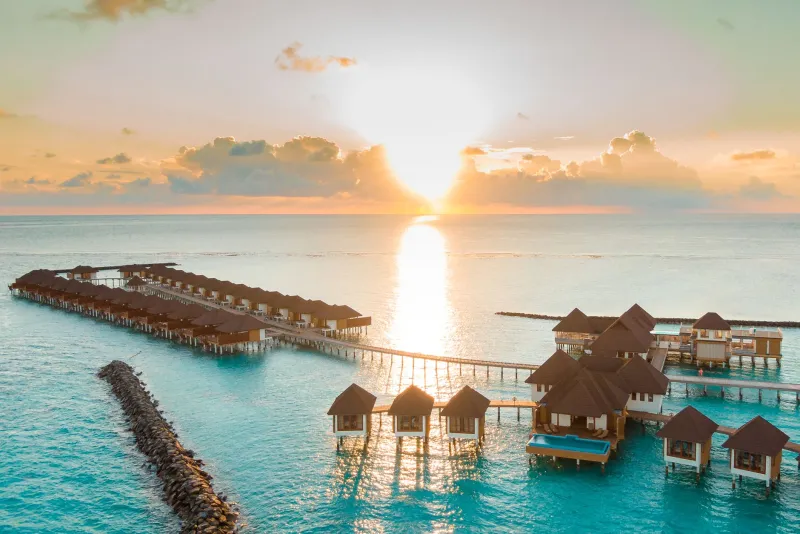
You know the feeling. The seaplane lifts from the Lhaviyani Atoll lagoon, and somewhere between the turquoise water receding below and the connecting flight out of Malé, you make yourself a quiet promise: This time, I will hold onto this. This time, the clarity will last. The unhurried quality of attention you rediscovered over a week at Kanuhura will survive the commute, the inbox, the 8 a.m. Monday call.
And then, often within 72 hours of landing at JFK or O'Hare or LAX, it is gone. Not gradually — suddenly. The old cognitive patterns reassert themselves with startling speed, and the person who floated in a warm Indian Ocean lagoon watching a reef shark glide beneath them feels, somehow, like someone else entirely.
This is not a personal failure. It is neuroscience. And more usefully, it is a problem with documented solutions.
Why the Fade Happens So Fast
Behavioral psychologists refer to the phenomenon as "context-dependent state reversion" — the brain's tendency to reassociate with the neural patterns most strongly linked to a given environment. When you return to your apartment, your office, your commute, and your professional obligations, the brain does not simply continue in the state it achieved at Kanuhura. It pattern-matches to the context it recognizes and reinstates the cognitive architecture it has spent years building for that environment.
Dr. Wendy Wood of the University of Southern California, whose research on habit formation has influenced behavioral psychology for decades, describes the home environment as a powerful cue system — one that automatically triggers established behavioral and emotional routines. "We think of our habits as internal," she has written, "but they're actually stored in our environment as much as in our minds."
This is both the problem and the solution. If the environment drives the state, then modifying the environment — strategically and intentionally — is the most direct path to preserving the clarity and presence cultivated during a Kanuhura stay.
The First 72 Hours Are Critical
Research on memory reconsolidation — the neurological process by which experiences become stable, long-term patterns — suggests that the period immediately following a significant psychological experience is unusually malleable. The neural changes initiated during a week of genuine restoration have not yet fully consolidated. What happens in the first three days home plays a disproportionate role in determining how much of the experience ultimately persists.
For returning professionals, this argues strongly for protecting the re-entry period with the same intentionality applied to the departure. Practically, this means several things.
Resist the impulse to immediately "catch up." The inbox will survive another 24 hours. The temptation to re-immerse in professional obligations the moment the plane lands is understandable — but neurologically, it is the fastest route to erasing what Kanuhura built. Scheduling a buffer day between return and re-entry into full professional mode is not indulgent. It is strategic.
Document what you experienced before the details fade. Not a travel journal entry — a cognitive inventory. What did your thinking feel like at Kanuhura? What were you able to notice, consider, or feel that you typically cannot access? Writing this down creates a reference point — a description of the state you are trying to preserve and, eventually, to recreate.
Communicate your re-entry terms. High-performing professionals often return from restorative travel and immediately signal, implicitly or explicitly, that they are "back" — available, responsive, fully operational. This social contract reasserts the old cognitive context with remarkable speed. Allowing yourself 48 hours of partial availability is not a professional liability. It is a neurological investment.
Redesigning Your Environment for Presence
Once the re-entry period has passed, the more durable work of environmental redesign begins. The goal is not to recreate the Maldives in a Manhattan apartment — that is neither possible nor the point. The goal is to identify the specific environmental conditions at Kanuhura that supported your preferred cognitive state, and to introduce functional equivalents into your daily environment.
Light management is underrated. Kanuhura's equatorial light — warm, abundant, and naturally timed — is among the most powerful environmental regulators guests experience. Back home, investing in circadian lighting systems (Philips Hue and LIFX both offer programmable warm-spectrum options) to replicate the transition from energizing morning light to warm, low-stimulus evening light produces measurable effects on mood and sleep quality. The goal is to stop living under the flat, blue-spectrum overhead lighting that most American homes and offices default to.
Create a genuine morning buffer. One of the most consistent observations among Kanuhura guests is the quality of the morning — the absence of an immediate agenda, the permission to simply exist for an hour before the day makes its demands. In professional life, this is not automatic. It must be engineered. Waking 45 minutes earlier than strictly necessary, leaving devices in another room until a morning ritual is complete, and establishing a consistent physical practice — whether movement, meditation, or simply sitting with coffee in silence — creates a daily neurological reset that accumulates meaningfully over weeks.
Introduce blue space where possible. The research on proximity to water environments is robust. For city-dwelling professionals, this may mean positioning a workspace near a window with a natural view, incorporating a regular Saturday morning near a body of water, or — less intuitively but genuinely effective — using high-quality ambient sound environments (Endel and Brain.fm both offer water-based soundscapes calibrated to specific cognitive states) during focused work periods.
The Weekly Architecture of Restoration
Beyond daily habits, the guests who most successfully preserve the Kanuhura effect are those who build a weekly architecture that includes at least one period of genuine, unstructured restoration — not productivity-adjacent "self-care," but actual open time with no outcome requirement.
Behavioral psychologist Dr. Adam Grant of the Wharton School has written extensively on the relationship between what he terms "psychological detachment" and sustained professional performance. His research consistently demonstrates that workers who fully disengage from professional identity during off-hours — not merely stopping work, but genuinely releasing occupational concerns — outperform those who remain partially tethered across virtually every performance metric.
Kanuhura creates the conditions for this detachment almost automatically, through its physical isolation and the absence of professional context cues. At home, it must be constructed deliberately: a Sunday afternoon with no agenda, a Saturday morning without a phone, an evening walk taken for its own sake rather than as exercise optimization.
Planning the Return to Kanuhura
Perhaps the most psychologically useful thing a returning guest can do — and this is supported by research on anticipatory positive affect — is to schedule the next visit before the last one fully fades.
Studies on the psychology of planned experiences consistently demonstrate that having a meaningful future experience to anticipate produces measurable improvements in present-moment well-being, independent of the experience itself. The act of booking — of establishing that the Indian Ocean is not behind you but ahead of you — reconfigures the relationship between daily professional life and the restorative state Kanuhura represents.
The week at Kanuhura is not the destination. It is the practice. And like all meaningful practices, it produces its greatest returns not in a single visit, but in the sustained relationship between who you become there and who you choose to remain when you return.