The Thinking Executive's Retreat: How a New Breed of Leader Is Redefining Productive Travel
Photo: Pete Souza, Public domain, via Wikimedia Commons
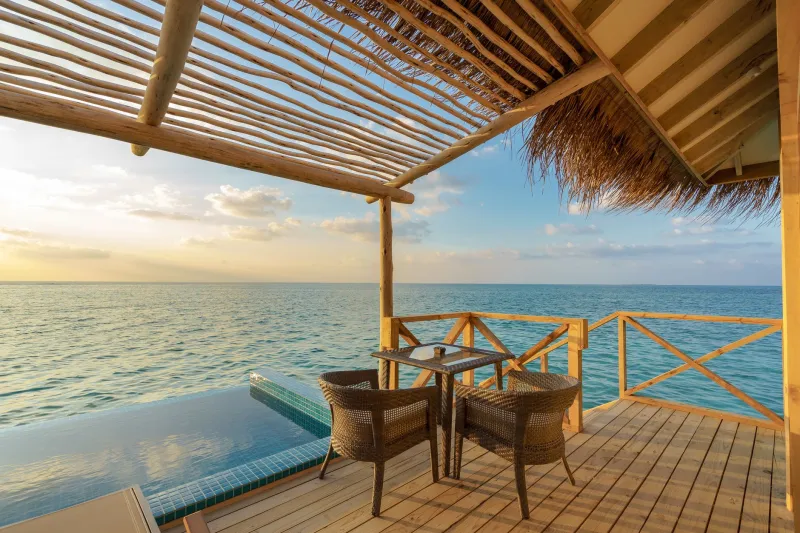
The memo arrived at 6:47 in the morning, Maldives time. Its author — a San Francisco-based founder whose company had recently crossed the two-billion-dollar valuation threshold — was seated on the terrace of a water villa at Kanuhura, watching the Indian Ocean shift from charcoal to copper as the sun cleared the horizon. He had been awake for forty minutes. In that time, he had also drafted the strategic framework that would define his company's next product cycle, completed a voice memo outlining his thinking on a pending acquisition, and consumed one cup of coffee.
He would not describe this as working. He would not describe it as vacationing either.
"There's a third thing," he said, in a conversation some weeks later. "I don't have a word for it yet. But it's the state where the thinking happens that can't happen anywhere else."
He is not alone in this observation — nor in the deliberate construction of the conditions under which it occurs.
The Collapse of the Work-Vacation Binary
For most of the twentieth century, American professional culture operated on a relatively stable understanding of vacation: it was the period during which one stopped working. The value of that cessation was understood to be restorative, and the restoration was understood to be preparation for more work upon return. The two modes — working and not working — were distinct, sequential, and rarely questioned.
That model has been quietly dissolving for the better part of a decade, driven by a combination of technological capability, shifting professional identities, and the growing recognition among elite performers that their most valuable cognitive output does not follow a nine-to-five schedule and cannot be switched on and off by a calendar.
"The executives and founders I work with don't think of themselves as people who work and then rest," observes Alexandra Voss, an executive coach whose practice focuses on CEOs and C-suite leaders at growth-stage companies. "They think of themselves as people who think — continuously, at varying depths and velocities. The question they're increasingly asking is not 'when can I stop working' but 'what conditions produce my best thinking.'"
The answer, for a significant and growing number of them, involves leaving the country.
Why Geography Changes the Quality of Thought
There is a well-documented relationship between physical environment and cognitive performance that goes well beyond the conventional wisdom about "getting a change of scenery." Research in environmental psychology has established that specific environmental conditions — reduced cognitive load, access to natural settings, thermal comfort, acoustic calm — have measurable effects on the quality of executive function: the cluster of mental capabilities that includes strategic planning, creative problem-solving, and the integration of complex information.
The irony that many of the most demanding professional environments in America are also among the most cognitively hostile — open offices, constant interruption, the ambient anxiety of high-stakes organizational life — is not lost on the leaders who have begun seeking alternatives. What they have discovered, often through trial and iteration, is that the quality of their thinking is not a fixed personal attribute. It varies substantially with the conditions under which it is deployed.
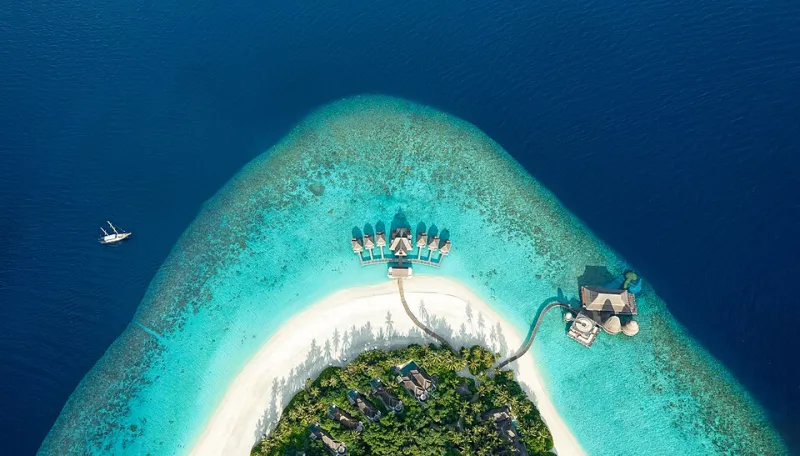
Kanuhura Maldives presents a set of conditions that, when examined against the environmental psychology literature, reads almost as a designed experiment in optimal cognitive performance. The thermal environment of the Lhaviyani Atoll — consistently warm, humidity-moderated by ocean breezes — aligns with research indicating that moderate warmth enhances creative and associative thinking. The absence of visual complexity reduces what cognitive scientists call "ego depletion" — the gradual exhaustion of decision-making capacity that cluttered urban environments accelerate invisibly. The ocean horizon, which the human visual system is uniquely calibrated to find restful, provides a form of passive engagement that allows the prefrontal cortex to operate without the defensive vigilance that most professional environments demand.
Put simply: the brain works differently here. And for executives whose competitive advantage is fundamentally cognitive, that difference has material value.
Selective Connectivity as a Strategic Tool
The work-reimagined retreat is not, critically, a vacation with a laptop. The distinction matters, and the most sophisticated practitioners of this model understand it with precision. The goal is not to import the full texture of office life into a beautiful location — that experiment has been tried and found wanting. It is to create conditions of selective connectivity: the deliberate choice of which professional engagements to bring into the restorative environment, and which to leave behind.
For most executives who have refined this approach, the selection criteria are consistent. Deep, generative work — strategic thinking, creative problem-solving, the kind of writing or planning that requires extended uninterrupted attention — travels well to transformative environments. Reactive work — email management, scheduling, the endless maintenance of organizational systems — does not, and its intrusion into the retreat environment tends to contaminate rather than complement the restorative experience.
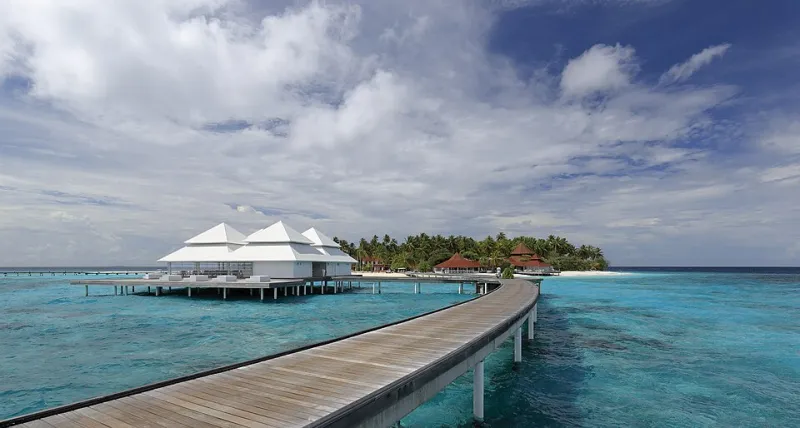
Kanuhura's connectivity infrastructure supports this distinction with unusual elegance. High-speed internet access is available throughout the resort, ensuring that the executive who needs to make a video call to a board member or review a critical document is never genuinely cut off. But the architecture of the resort — the physical separation of villas, the absence of co-working spaces and business centers, the orientation of every structure toward the ocean rather than toward screens — creates a persistent environmental cue toward depth over reactivity.
"The environment makes the right choice easier," notes Voss. "When you're sitting on a terrace looking at the Indian Ocean, the gravitational pull is toward big thinking. The inbox can wait. The inbox always can wait."
The Operational Logic of the Hybrid Retreat
For the executives and founders who have adopted the work-reimagined retreat as a regular practice, the operational details have become increasingly refined. Most arrive having completed what one founder describes as "pre-clearance" — the deliberate closure of outstanding decisions, delegations, and communications that would otherwise create cognitive drag during the retreat period. The goal is to arrive with a clean mental slate, not an empty calendar.
The daily rhythm at Kanuhura accommodates the hybrid model with a naturalness that more explicitly "business" destinations rarely achieve. Morning hours — when research consistently shows executive cognitive function at its peak — are typically allocated to deep work, conducted from villa terraces or private beach access points where the combination of natural light, fresh air, and ocean proximity creates conditions that many describe as uniquely generative. Afternoons shift toward recovery activities: diving the resort's pristine house reef, exploring the island's sandbanks by private vessel, or simply inhabiting the restorative stillness that the Indian Ocean provides in such abundance.
Evenings, at Kanuhura, occupy a category of their own. Dinner at the water's edge, the bioluminescent shimmer of the lagoon, the particular quality of silence that descends on a private island after dark — these are not neutral experiences. They are integrative ones, the kind that allow the day's thinking to settle and consolidate in ways that sleep alone cannot accomplish.
The Return on Investment That Doesn't Appear on a Balance Sheet
The executives who have built this model into their professional practice are, by and large, not given to imprecision about outcomes. They track what works. And what they report, consistently, is that the thinking that happens at destinations like Kanuhura — the decisions made, the strategies formed, the creative solutions surfaced — tends to be qualitatively different from the thinking that happens in their offices.
Not different in a vague, inspirational sense. Different in the sense that matters most to people who build and lead consequential organizations: clearer, more original, more durably sound.
The Indian Ocean, it turns out, is an exceptional place to run a company — at least for the three days during which your best thinking about that company can happen without interruption. The office will still be there when you return. The question is whether the thinking you bring back to it will be worth the journey.
At Kanuhura, the answer has a way of making itself obvious.